Water use and climate impact are two distinct issues (their connections notwithstanding). Californian almond farming is a catastrophe for regional water systems, but its greenhouse gas emissions aren’t much of a concern. Conversely, rice farming on flooded fields has substantial greenhouse gas emissions despite its being rather unproblematic for regional water systems.
Substantial is severely overstated as any crop you would replace rice with where rice is grown in water would objectively destroy all local water cycles if not the entire local ecosystem. That would have a much greater impact on climate change than if rice accounted for 100% of all calories eaten globally.
A) Rice paddies are generally in wetlands and swamps, protecting these areas, any other grain you would grow here would destroy that wetland biome. Corn especially would essentially render the entire area sterile because
B) Domesticated rice grown in water does not use any pesticides or herbicides whatsoever. There’s no need for it. Occasionally, in specific areas, you’ll need scare crows, frequent human activity, or crabs/ducks depending on the exact pest you’re getting rid of, but you don’t need glyphosate. This has massive knock on effects for climate, fewer herbicides and pesticides means more carbon being sequestered. Fewer herbicides and pesticides in water means more microorganisms turning CO2 back into oxygen and sequestering the carbon in tasty tasty microscopic corpses. Which brings us to
C) Methane and the GHG cycle: While methane is a much more effective greenhouse gas than CO2, it also has practically no shelf life in the atmosphere. It is a natural part of the GHG cycle and even if all grains everywhere were converted to rice, we could not generate enough methane to effect the climate. It would decay to hydrogen within ten years in the upper atmosphere (versus 50 or more for CO2) but more importantly every single type of forest sequesters it more efficiently than CO2. Saying a natural source of CH4 that is easily accounted for by growing it upwind of a forest, like it almost always is, is a serious driver of climate change or even a risk for it is silly doomerism.
The truth is climate change is 100% a matter of fossil fuels. If we stop using fossil fuels, we will immediately stall climate change. Nothing else we can realistically do except burning fossil fuels will cause climate change, and even if we go full net zero on every other thing we do, without stopping fossil fuels, we will not make any progress whatsoever. Even if we used 100% ethanol fuel in ICE vehicles, we would stop climate change. Because we would not be introducing ancient sequestered energy back into the system, we would be taking energy from the system one year, and putting it back in the next.
Rice is the same. All methane renewed by growing rice will be sequestered or decayed in less time than it will take for properly dried and stored rice to decay, and none of whats generated would effect the total amount of methane circulating in the system.

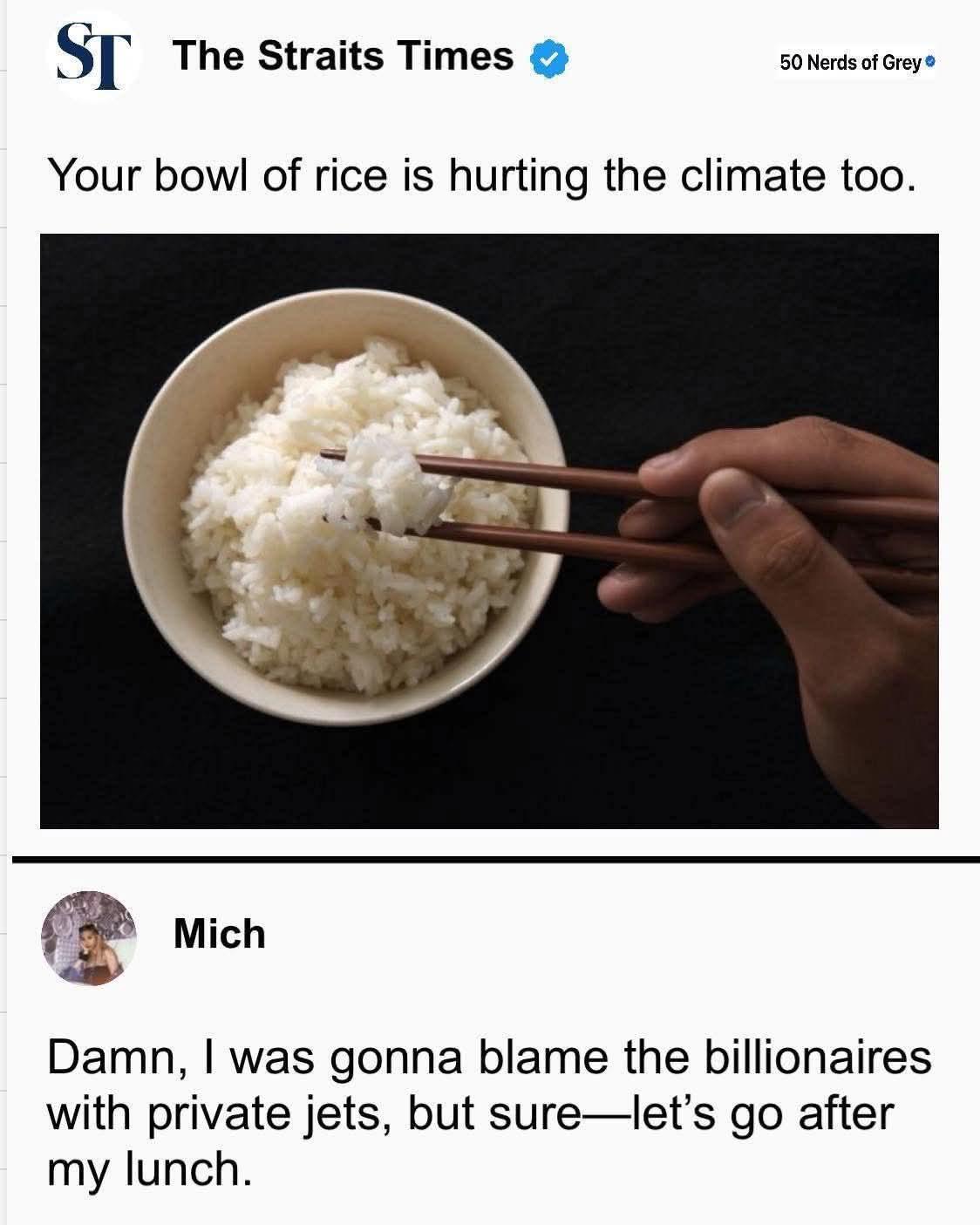
Water use and climate impact are two distinct issues (their connections notwithstanding). Californian almond farming is a catastrophe for regional water systems, but its greenhouse gas emissions aren’t much of a concern. Conversely, rice farming on flooded fields has substantial greenhouse gas emissions despite its being rather unproblematic for regional water systems.
Substantial is severely overstated as any crop you would replace rice with where rice is grown in water would objectively destroy all local water cycles if not the entire local ecosystem. That would have a much greater impact on climate change than if rice accounted for 100% of all calories eaten globally.
A) Rice paddies are generally in wetlands and swamps, protecting these areas, any other grain you would grow here would destroy that wetland biome. Corn especially would essentially render the entire area sterile because
B) Domesticated rice grown in water does not use any pesticides or herbicides whatsoever. There’s no need for it. Occasionally, in specific areas, you’ll need scare crows, frequent human activity, or crabs/ducks depending on the exact pest you’re getting rid of, but you don’t need glyphosate. This has massive knock on effects for climate, fewer herbicides and pesticides means more carbon being sequestered. Fewer herbicides and pesticides in water means more microorganisms turning CO2 back into oxygen and sequestering the carbon in tasty tasty microscopic corpses. Which brings us to
C) Methane and the GHG cycle: While methane is a much more effective greenhouse gas than CO2, it also has practically no shelf life in the atmosphere. It is a natural part of the GHG cycle and even if all grains everywhere were converted to rice, we could not generate enough methane to effect the climate. It would decay to hydrogen within ten years in the upper atmosphere (versus 50 or more for CO2) but more importantly every single type of forest sequesters it more efficiently than CO2. Saying a natural source of CH4 that is easily accounted for by growing it upwind of a forest, like it almost always is, is a serious driver of climate change or even a risk for it is silly doomerism.
The truth is climate change is 100% a matter of fossil fuels. If we stop using fossil fuels, we will immediately stall climate change. Nothing else we can realistically do except burning fossil fuels will cause climate change, and even if we go full net zero on every other thing we do, without stopping fossil fuels, we will not make any progress whatsoever. Even if we used 100% ethanol fuel in ICE vehicles, we would stop climate change. Because we would not be introducing ancient sequestered energy back into the system, we would be taking energy from the system one year, and putting it back in the next.
Rice is the same. All methane renewed by growing rice will be sequestered or decayed in less time than it will take for properly dried and stored rice to decay, and none of whats generated would effect the total amount of methane circulating in the system.
I never did understand why we didn’t just grow the almonds in the rain soaked south east. It’s not like they don’t travel well.