Sure. Sure. Insert your own example of applying the sins of a particular implementation of a technology to a hierarchical supergroup. That was an example I came up with in a few minutes on the shitter, not a deep philosophical argument.
_ is bad, because (specific implementation) has these flaws!
That’s the issue being discussed here. It’s misleading without precision.
most electric cars are teslas so like a statistical analysis would be mostly correct.
propaganda against electric cars is generally just propaganda against cars in general, for example:
if full self driving becomes a thing you can expect traffic to become MUCH worse as like one minivan for a parent with 3 kids is replaced by four self driving cars that drive each kid around and one for the parent. This could lead to traffic jams at every subburb
I’m just saying the original post is conflating criticisms against a particular implementation of blockchain with all blockchain.
“The wright brothers invented a useless machine they called the airplane. It only held one person and could fly for only a limited duration. It was also extremely dangerous.”
Well that’s very different than anything happening in the thread so yes its very silly.
The old newspapers are full of critiques of the ford model T and conflating them with all cars, most of those criticisms apply only to early cars. I think that’s what you’re getting at here.
But realistically in context the criticisms make sense. I would go as far as to say its more a problem that enthusiasts havent renamed bitcoin as a “cryptoasset” since its not useful as currency and apply “cryptocurrency” only to proof of stake designs.
Or as an analogy, it would be like calling a motorcycle a type of bicycle, which is more or less true, but its so goddamn different in use they had the sense to rename it so normal people would be able to tell them apart.
I think its mostly for most people “crypto” = “cryptocurrency” = “bitcoin” even though there’s some categorical umbrellas there and I don’t think there’s a way to fix it without redefining cryptocurrency to only include currencies and specifically exclude bitcoin and similar coins. Blockchain has a similar problem because its used as a synonym for crypto.
Immutable so long as no one party or group owns more than half of the coins on a given blockchain… then the ledger is whatever they say it is and it propagates down because they can manufacture their own “consensus”.
It’s not 51% of the coins, it’s 51% of the computing power on the network. Both of which are virtually impossible in the case of Bitcoin, though not entirely impossible. I just wouldn’t consider a 51% attack even remotely a threat to the network compared to something like government crackdown
I’m not an expert, but I never understood why people would prefer PoS over PoW. Indeed, the latter requires to “waste” larger amounts of energy, but doesn’t PoS favor rich groups of people colluding against the blockchain timeline?
Let’s think about this. Ethereums total market cap is $325b, if you tried to buy anywhere near half the market cap, you would drive the price up so egregiously that not even the US Government could probably afford it, and so many people would get suspicious and stop selling, that it likely would be impossible…but, even if you could, the action of falsifying even 1 transaction and getting caught would absolutely wreck the entire value of the chain driving it to zero. So you would have to spend probably on the order of $1 trillion dollars or more to effectively delete your money.
The only reason that would ever happen, and this would be quite the extreme, is if a large government like the US or China, saw it as so much of a threat, that they would go to this length instead of just banning it and letting it fizzle out.
Even if an entity could throw away $1T, there are many other ways to devalue crypto or make it untrustworthy. $1b of thugs, propaganda, and lobbying is way way more effective.
Not anymore than PoW, which requires specialized hardware that can’t be repurposed for other uses (and thus requires money to enter). I’m not sure if is still true, but I believe at one point less than 10 companies had over 51% of the BTC network.
Because ownership tends to be much more evenly distributed than ACIS ownership, it makes it harder to collude - you have to have 51% of all coins that are staked (and smaller owners generally pool to stake as well). In addition, a move to collude would almost instantly destroy the value of the staked coin (though maybe not assets tokenized on it), providing another incentive against it.
Immutable so long as no one party or group owns more than half of the coins on a given blockchain… then the ledger is whatever they say it is and it propagates down because they can manufacture their own “consensus”.
No, the community controls the consensus through their nodes. A 51% attack only allows the attacker to perform:
A double spend attack - sending a transaction, receiving the goods and then reorganizing the chain to undo the transaction.
Censoring transactions.
In the event of a 51% attack the community can fork the chain - change the consensus and implement preventive measures like changing the mining algorithm, changing to PoW/PoS, banning all of the attackers coins, implementing a finality layer or a checkpoiting system etc.
You are making my point. Blockchain is not crypto. Blockchain can be useful in private, internal use cases (like a transaction ledger for bank branches) where trust is largely implicit.
Distributed / immutable databases are not solely a feature of blockchain either.
It’s a very interesting thing in a vacuum. Basically any application of it so far (with the possible exception of the original one, if it weren’t just a speculation investment machine at the moment) runs into the problem where it has to interact with reality at some point. And most of the problems Blockchains solve are already solved by a variety of other systems, for less time/currency/hardware investment.
Because it’s an immutable ledger, not just a database. It maintains a history of every previous transaction/entry. Blockchains are used by banks and in the supply chain because it makes backtracing and identifying discrepancies trivial. For things like cryptocurrency, blockchains allow “don’t trust, verify” but for something where you already have trust, they allow “trust but verify”
Cryptographically immutable append only ledgers (aka merkel trees) have existed since at least 1979. A blockchain is different because it has distributed consensus. If your consensus algorithm is trust, then it’s not a fucking blockchain.
A blockchain is nothing more than a data structure. It’s essentially a linked list using the hash of the previous block. Distributed consensus is something blockchains are useful for, but it doesn’t define it
This is a good comment that makes all good points. But I just wanna say let’s stop saying “blockchain” singular and with no preceding article like we’re tech CEOs and it’s some immutable god. They’re blockchains, plural, like any other data structure there can be more than one and there are. eg The blockchain of ethereum is distinct from the blockchain for bitcoin but they are both blockchains.
Valid point! But then how do you refer to the data structure/architecture/model concept? Sometimes we want a concise term (like bittorrent or ActivityPub) for the abstraction
It’s a novel data structure, we can refer to it like we do other data structures: Linked lists, hash tables, primitives. The branded implementation of these things is what we typically make singular: Bitcoin, ethereum, monero (bittorrent, activitypub…)
Bittorrent implements a torrent swarm, activitypub implements a federated social network.
The only alternative to proof of work is proof of stake. And if the world ever ran on proof of stake crypto, it would make today’s wealth inequality look like a Marxist paradise.
What matters is whether or not there’s any significant profit - the reward being bigger than the cost. PoW minimizes this with difficulty adjustment flushing most profits down the toilet. PoS must always have a return competitive with other investments.
Profits should be low, or else it promotes inequality.
You get one asset with worse interest that can be spent (like dollars), and one asset with better interest that can’t be spent (like bonds). The poor hold the former, the rich hold mostly the latter.
If there’s a low barrier to entry then you’re just reinventing POW because someone can run as many nodes as possible with minimal stake in order to maximize returns. Can you give an example of one successful “fixed rewards” Crypto coin?
You are exactly the type of person I’m talking about :\
Crypto is not the only use case for blockchain.
Blockchain can be useful in inherently trusted, closed ecosystems.
Depending on the use case, proof doesn’t even need to be anything more than a valid certificate (not work, not stake)
Consider a bank that develops its own blockchain ledger for internal use only, replacing their branch ledgers (which require daily reconciliation and propagation).
An immutable, distributed ledger has plenty of valid, valuable use cases without looking like crypto.
“Internal use only” blockchain is an oxymoron. If all contributors are trusted entities, then what does it matter if the data is stored in a blockchain vs any other data structure? If anything the amount of extra work to maintain and modify the blockchain in the case of errors just makes it unnecessary.
If that’s the best example of its many “valid, valuable use cases”, then it’s still a pass from me, dawg.
But as long as you can have a trusted central authority, you don’t need blockchain without needing to trust all the clients. The central authority can enforce authentication and authorization for what each client can do, combine with proper logging it is already sufficient. Blockchain is only needed if there’s absolutely no central authority (which is not the case for any traditional business as by nature they already have a hierarchy where the top would act as the central authority, therefore any business that implements blockchain internally is just BS-ing).
Pretty obvious that its use in the first place was some FOMO executives trying to get in on “blockchain” technology, just like they’re doing with AI and LLMs now. Funny how BTC and ETH both plateaued a year ago, right around the time AI became the new thing.
I’m not going to bother reading the rest, I already wasted too much time arguing with a true believer. GL with the crypto that you say you don’t have.
Lol you’re a judgemental prick. I have zero crypto because that shit is absolutely moronic.
It’s like you talked to someone who supports nuclear power and responded “good luck with the nuclear bombs you definitely don’t have, true believer”
Sounds like you just want to hate on shit you don’t understand. Go on with your bad self though 👍
EDIT: LMAO from the article you linked they even point out that the tech itself isn’t the problem, but the willingness of businesses to invest in the improvements (which is, like, an incredibly common problem in business that does not in any way make the tech bad)
Its plan to digitize global supply chains hasn’t received sufficient cooperation and support to remain viable.
That is the downside of corporate blockchain projects. They need everyone to share a mindset and commit to a long-term plan. Unfortunately, businesses face ever-changing conditions and financial problems. Few can warrant the cost of buying into such systems under the current market conditions.
You probably preach about how nuclear power is terrible, how if it were so great there would be more of it, and people sticking to coal is proof that coal power is better.
Then why hasn’t a better blockchain based currency gained any popularity? If they don’t have critical mass then your distinction is meaningless. It turns out there is just zero real world need for an untrusted distributed ledger. Databases and governments solve the problem much better.
Questioning the technical virtues of an alternative product based on lack of critical mass adoption is pretty funny, when you consider we’re on the fediverse. I know that doesn’t defray your argument, but just an amusing observation.
I see why you might draw the comparison, but I actually don’t think the comparison is valid at all. Forums/communities can still be useful and fun with only a few people. Discord is also massively popular with a small community model, for a more successful example to compare with the fediverse. However a currency that nobody uses or accepts is entirely useless until mass adoption happens. That’s why they typically get mandated by force by governments.
You don’t need mass adoption to be useful, the more adopted a currency is the more useful it becomes but it’s not binary. Seychelles has a population of 130k, does that mean that the seychellois rupee is useless? Of course not, 130k people use it everyday.
~100 milion people use or at least own bitcoin, meaning they would probably be willing to pay or accept payment in it, that’s 1.3% of the world’s population, 1 in 80 people, that puts bitcoin between the Japanese yen and the British pound. ~260 milion people use crypto currencies in one way or another, over 3% of world’s population, 1 in 30 people, that’s just under the euro or the us dolar. And if you use 1 crypto you basically know how to use them all, just like €,$,£. If that’s not mass adoption I don’t know what is.
Most merchants who accept ₿ also accept other cryptos like ethereum, stable coins, litecoin, monero, tron, bitcoin cash… There are payment gateways that make it incredibly easy and automatically convert to your currency of choice, so there is no reason not to accept even the shittiest of shitcoins if it will be swapped before it even gets to you.
People bring up crypto because it is the only use of blockchain that isn’t worse than already established methods. And crypto is only “better” because it’s unregulated and allowed a bunch of scams to be pulled.
Uses of blockchain other than cryptocurrency that just came to my mind, some are already functioning or being introduced:
Decentralized, trustless, uncensorable domains that don’t require kyc to purchase.
Decentralized, trustless, uncensorable replacement for certificate authorities that can’t be hacked as easily as CAs can.
Decentralized, trustless, uncensorable server for small data like pgp signing keys, torrent magnet links, file hashes, static websites, code etc.
Decentralized, uncensorable, distributed way to store archival information or historical records like weather data, government document records, wikipedia edit history, book versions. Anything that shouldn’t change or is in danger of getting censored.
Automated financial markets open to the public through tokenization like stocks, bonds, commodities all settled on chain without 3rd parties.
Trustless on-chain contracts/smart contracts that will execute automatically or can be proven without a notary.
Decentralized, uncensorable, trustless identity system
No. Domains can be seized and blocked by countries via dns blocklists, anna’s archive just lost one of their domains recently, so has z-library, the pirate bay… European governments have been forcing isps to introduce dns blocklists for the websites they don’t like. Certificate authorities have been hacked before, can be coerced by governments to perform MITM attacks and require trust. The only reason why certificates are even remotely accessible to regular people is thanks to EFFs certbot, hosting providers can charge thousands of $ per year for a simple SSL certificate. There’s no reason for that when a cert and a domain name could be recorded on a public distributed ledger (blockchain) openly accessible and independently verified by thousands of nodes, no trust, no authority, no single point of failure, almost no chance of a MITM attack. Here I outlined how that would work exactly https://discuss.tchncs.de/comment/10423786
Same thing with a pgp key server, magnet link repository etc. How many torrent sites went down and took their content with them? How many open source projects have been DMCAd and forced to shutdown, some without any legal grounds just by threatening frivolous lawsuits? Good luck taking down the entire blockchain, especially one not only dedicated to torrents. Always up, uncensorable, verifiable from beginning to end, publicly accessible with thousands of endpoints. How can you argue that’s not better than a centralized server that lives and dies by the will of one dude or his isp/vps provider or some company or government. Historical data like weather info, currency exchange rates or any other record always up, uncensorable, fully verifiable, freely available to anyone who wants via an online API with thousands of endpoints or by querying your local version of the blockchain instead of through a centralized, often paid online service. Trustless smart contracts are unique to blockchains, you can’t do them any other way because they require a trustless execution layer only a blockchain can provide, otherwise you’d have to trust some 3rd party who controls the computer. Tokenized financial markets give regular people easy access to the market without the need for a broker who will take fees, can dissable buying/selling like robinhood did during the GME short squeeze, can front run it’s clients etc. It’s literally revolutionary tech being adopted by companies in and outside of the financial sector and governments around the world. Insane how people still dismiss it because “bitcoin uses blockchain and bitcoin wastes energy so blockchain bad” even when no proof of work or crypto currency is involved, not to mention that mining, smelting, transporting gold or silver also wastes energy and human work for a pretty useless metal that outside of some niche applications demand for which could be easily satisfied +1000 fold with our current supply is exclusively used to store value, that printing, securing, transporting cash wastes energy and a lot of human work. Digital fiat also has to be handled by a bank that needs servers, milions of ATMs and HUNDREDS OF THOUSANDS OF EMPLOYEES all of whom have to drive to and from work, have their building heated and lit, have a computer and whole infrastructure that needs to be maintained just to function not even 24/7, slower and less reliability than a crypto currency that doesn’t even require proof of work mining anymore, wastes a fuckton more energy and human effort than 10 bitcoin networks ever could. There’s nothing inherently inefficient about blockchains, for example the small data server example I provided is literally pretty much just a decentralized, uncensorable, trustless, permisionless, verifiable, community run CDN (content delivery network) which is more efficient than a single centralized server.
If [other applications of the blockchain, which has now existed for an extremely long time] don’t have critical mass then your distinction is meaningless.
I’m not convinced there’s any internal use for blockchain. Internal implies under a specific umbrella, some overarching organisation, who can then be the central trusted server that makes blockchain unnecesary.
That said, non-public but open uses, such as tracking dealings between companies in markets with little trust and no single governments (the shipping example in your referenced comment) is indeed the thin slither of a plausible use-case.
Another limitation is that blockchain loses its benefits if anyone tries to design over the complexity of using it directly (using a ui that under the hood uses blockchain is no different to using a ui that talks to a central database, you’re trusting the central ui provider, you need to (at least be able to) build your own interface to realise the benefits of blockchain.
That means blockchain basically will never benefit individuals, it can’t. Sure, you could have multiple compatible uis shared around, but that’s no different security-wise to multiple central banks with an interoperable transfer system.
The only place blockchain has real benefits is when multiple large corporations/governments are interacting and don’t trust eachother/anyone.
See the link in my other replies for some examples of internal uses that still benefit from immutable, distributed ledgers.
Large organizations still have loss and risk from individual bad actors. Operating a central authority that validates every single transaction in a ledger, and validates ledger history and consistency, can be prohibitively complicated. A well designed blockchain implementation can resolve most of these issues.
A great example is a pharma/healthcare company that wants to manage medicine batch and expiration tracking, as well as distribution/patient assignment. With a traditional infrastructure every participant needs to phone home to a central authority. In a blockchain setup, peers can report ledger events one hop up and propagate it through the chain.
That’s a very simple example but I hope it gets my point across
Etherium and virtually the whole rest of the crypto scene that is “not bitcoin” has pretty soundly rejected the wasteful Bitcoin design. There was even a fork of Bitcoin that would have used the much more efficient proof-of-stake, but since that would be bad for everyone with a proof-of-work “mining” rig it didn’t take over.
It turns out there is just zero real world need for an untrusted distributed ledger
An “untrusted distributed ledger” is literally the backbone of modern software development. While you could plausibly split hairs and assert that git requires “trust”, I don’t think you’d wind up in a spot that both supports your assertion and a cognizable difference for anyone but mathematicians and security nerds. (And even if you did, the exact same sort of non-scam usages of blockchains are ones that operate like git, with the ledger used for something else.)
The most distinguishing feature is that it’s private by default, the sender, receiver and the amounts are cryptographically hidden from uninvolved parties. Other than that
Tiny fees - fees are only used to prevent spam, not to replace block rewards.
Tail emissions - every block rewards the miner with 0.6 XMR ensuring chain security, keeping the fees low and the inflation predictable and small - forever approaching 0 but never reaching it.
Variable block sizes - the block size grows and shrinks with the demand, allowing for more transactions when demand is high but still limiting spam.
RandomX mining algorithm - ASIC resistant mining algorithm best mined with the CPU ensures fair access to mining and prevents big minig firms from taking over the mining process.
Community and culture - the focus of most other cryptos is investing and speculation while monero’s focus is on being the best private, uncensored, p2p money. Because of this while other cryptos encourage their users to HODL their coins, monero users are encouraged to save and also spend their coins, treat them like digital cash rather than something who’s only purpose is to go up in price. In my opinion this culture leads to several things:
Business acceptance - many privacy centric services like VPN, VPS, e-sim, phone top up, gift card providers etc. accept monero. Usually any service that does, sees it at the top of the chart as the most used crypto, often more than all the other coins combined. Many open source projects accept it for donations as well, with similar findings.
Community built infrastructure - the monero community focuses on building the infrastructure around the idea of monero being digital cash. Things like xmrbazaar.com, a monero based e-bay/craigslist like market where you can buy/sell things for monero, kuno a monero based gofundme alternative for fundraisers, retoswap.com an instance of haveno, a decentralized, p2p monero exchange, monerica.com a repository of monero accepting business and other monero related things are designed with the idea of treating monero as money.
Price stability - because of the fact that monero is actually used for payments it’s price is established through adoption rather than speculation which makes it fairly stable in comparison to the rest of the crypto market, thanks to this you can safely spend and receive monero without worrying that a month from now it will loose 50% of it’s value. Of course, there are peaks and valleys often caused by the macro market movements like the recent few day pump to $800 and crash back to $400 but that’s an exception rather than the rule, for the most part (excluding stable coins) it’s one of the most stable cryptos out there with a slight long-term uptrend.
P2pool if you want to receive your rewards in a reasonable timeframe, there’s almost no reason to solo mine… but there is something cool about it and finally finding that block so personally that’s what I do. https://odysee.com/@crypt0_bear:7d/solo-minning-monero-music-video:1
Cryptocurrency development makes a whole bunch of arbitrary value-guided decisions during creation, all of these decisions have tradeoffs such that nobody has figured out a way to feature them all at the same time, or would they want to.
For example, bitcoin is fully auditable. Anyone with a copy of the bitcoin blockchain can review every single transaction in bitcoin’s history, and trace the flow of every last satoshi from it’s mining to today. This is because the developers of bitcoin place a high value on verifiable auditability and security. Conversely monero was developed for the purpose of being a completely untraceable, unauditable currency that still has a knowable supply. And ethereum was created in a manner that intentionally supported scripting, so that it could be used as a platform for novel applications and contracts. None of these primary features could be ported to either of the other two without breaking them completely, because of the deep programmatic implications of the requirements.
It’s not really a question of better or worse, but of use case. The fact of the matter is that the reason these three examples are the leading currencies for their use case is literally because nobody has yet been able to do a better job. And for bitcoin at least, at this point it’s security rests just as much in it’s wide adoption and interest as it’s design intent, so it’s unlikely that anyone ever will.


sigh
Once again:
Blockchain is not synonymous with cryptomining
Blockchain does not require proof of work
Cryptocurrency and NFT grifting does not devalue blockchain as an immutable distributed ledger
I swear to god people just copy paste whatever makes them feel good without any effort at understanding
True… But Satoshi did invent Bitcoin, which is proof of work, and is everything in OP
Except it says blockchain in the toot?The “technically true” nature of it reads like propaganda against electric cars as a whole, does it not? I’d argue that applies here too.
“Popularized” the electric car, maybe?
There were electric cars since there were cars
Popularized it is. I was careful to not put invent, but morning brain not work good.
Fair enough, I forgot that OP said “blockchain,” instead of “bitcoin.”
Your example is not even close to technically true.
Sure. Sure. Insert your own example of applying the sins of a particular implementation of a technology to a hierarchical supergroup. That was an example I came up with in a few minutes on the shitter, not a deep philosophical argument.
_ is bad, because (specific implementation) has these flaws!
That’s the issue being discussed here. It’s misleading without precision.
most electric cars are teslas so like a statistical analysis would be mostly correct.
propaganda against electric cars is generally just propaganda against cars in general, for example:
if full self driving becomes a thing you can expect traffic to become MUCH worse as like one minivan for a parent with 3 kids is replaced by four self driving cars that drive each kid around and one for the parent. This could lead to traffic jams at every subburb
Doesn’t have to be cars.
I’m just saying the original post is conflating criticisms against a particular implementation of blockchain with all blockchain.
That’d be a silly sentence, would it not?
Well that’s very different than anything happening in the thread so yes its very silly.
The old newspapers are full of critiques of the ford model T and conflating them with all cars, most of those criticisms apply only to early cars. I think that’s what you’re getting at here.
But realistically in context the criticisms make sense. I would go as far as to say its more a problem that enthusiasts havent renamed bitcoin as a “cryptoasset” since its not useful as currency and apply “cryptocurrency” only to proof of stake designs.
Or as an analogy, it would be like calling a motorcycle a type of bicycle, which is more or less true, but its so goddamn different in use they had the sense to rename it so normal people would be able to tell them apart.
What are the differences that you see?
I think its mostly for most people “crypto” = “cryptocurrency” = “bitcoin” even though there’s some categorical umbrellas there and I don’t think there’s a way to fix it without redefining cryptocurrency to only include currencies and specifically exclude bitcoin and similar coins. Blockchain has a similar problem because its used as a synonym for crypto.
Why do you think LLMs are so popular?
Immutable so long as no one party or group owns more than half of the coins on a given blockchain… then the ledger is whatever they say it is and it propagates down because they can manufacture their own “consensus”.
https://www.investopedia.com/terms/1/51-attack.asp
and most use cases around things like “smart contracts” end up still requiring a trusted third party at some point
https://pluralistic.net/2022/01/30/the-inevitability-of-trusted-third-parties/
It’s not 51% of the coins, it’s 51% of the computing power on the network. Both of which are virtually impossible in the case of Bitcoin, though not entirely impossible. I just wouldn’t consider a 51% attack even remotely a threat to the network compared to something like government crackdown
That’s PoW. With PoS, it is coin ownership.
Which is much more distributed than computing power.
Correct, and this post is about Bitcoin, which is PoW.
I’m not an expert, but I never understood why people would prefer PoS over PoW. Indeed, the latter requires to “waste” larger amounts of energy, but doesn’t PoS favor rich groups of people colluding against the blockchain timeline?
Let’s think about this. Ethereums total market cap is $325b, if you tried to buy anywhere near half the market cap, you would drive the price up so egregiously that not even the US Government could probably afford it, and so many people would get suspicious and stop selling, that it likely would be impossible…but, even if you could, the action of falsifying even 1 transaction and getting caught would absolutely wreck the entire value of the chain driving it to zero. So you would have to spend probably on the order of $1 trillion dollars or more to effectively delete your money.
The only reason that would ever happen, and this would be quite the extreme, is if a large government like the US or China, saw it as so much of a threat, that they would go to this length instead of just banning it and letting it fizzle out.
Even if an entity could throw away $1T, there are many other ways to devalue crypto or make it untrustworthy. $1b of thugs, propaganda, and lobbying is way way more effective.
Not anymore than PoW, which requires specialized hardware that can’t be repurposed for other uses (and thus requires money to enter). I’m not sure if is still true, but I believe at one point less than 10 companies had over 51% of the BTC network.
Because ownership tends to be much more evenly distributed than ACIS ownership, it makes it harder to collude - you have to have 51% of all coins that are staked (and smaller owners generally pool to stake as well). In addition, a move to collude would almost instantly destroy the value of the staked coin (though maybe not assets tokenized on it), providing another incentive against it.
Can’t you just split it up into however many wallets you want? If you’re rich that seems like basic security.
No, the community controls the consensus through their nodes. A 51% attack only allows the attacker to perform:
In the event of a 51% attack the community can fork the chain - change the consensus and implement preventive measures like changing the mining algorithm, changing to PoW/PoS, banning all of the attackers coins, implementing a finality layer or a checkpoiting system etc.
You are making my point. Blockchain is not crypto. Blockchain can be useful in private, internal use cases (like a transaction ledger for bank branches) where trust is largely implicit.
If you have trust, why do you need a blockchain?
Distributed / immutable databases are not solely a feature of blockchain either.
It’s a very interesting thing in a vacuum. Basically any application of it so far (with the possible exception of the original one, if it weren’t just a speculation investment machine at the moment) runs into the problem where it has to interact with reality at some point. And most of the problems Blockchains solve are already solved by a variety of other systems, for less time/currency/hardware investment.
Because it’s an immutable ledger, not just a database. It maintains a history of every previous transaction/entry. Blockchains are used by banks and in the supply chain because it makes backtracing and identifying discrepancies trivial. For things like cryptocurrency, blockchains allow “don’t trust, verify” but for something where you already have trust, they allow “trust but verify”
Cryptographically immutable append only ledgers (aka merkel trees) have existed since at least 1979. A blockchain is different because it has distributed consensus. If your consensus algorithm is trust, then it’s not a fucking blockchain.
A blockchain is nothing more than a data structure. It’s essentially a linked list using the hash of the previous block. Distributed consensus is something blockchains are useful for, but it doesn’t define it
No, that’s a Merkel tree. Been around since 1979.
Nah, you can pretty easily define a Blockchain as a special case of a Merkel tree with a distributed consensus method.
Here, I provided a bunch of examples months ago of other ways blockchain is being used: https://lemmy.world/post/36683795/19677963
This is a good comment that makes all good points. But I just wanna say let’s stop saying “blockchain” singular and with no preceding article like we’re tech CEOs and it’s some immutable god. They’re blockchains, plural, like any other data structure there can be more than one and there are. eg The blockchain of ethereum is distinct from the blockchain for bitcoin but they are both blockchains.
Valid point! But then how do you refer to the data structure/architecture/model concept? Sometimes we want a concise term (like bittorrent or ActivityPub) for the abstraction
It’s a novel data structure, we can refer to it like we do other data structures: Linked lists, hash tables, primitives. The branded implementation of these things is what we typically make singular: Bitcoin, ethereum, monero (bittorrent, activitypub…)
Bittorrent implements a torrent swarm, activitypub implements a federated social network.
Shut up shut up shut up shut up shut up
Don’t ruin a good thing we’ve got going on here
First my buy order at 100K CAD just missed executing before the bottom bounce, now this?
What can I say? I woke up this morning and chose violence 🤷♀️
The only alternative to proof of work is proof of stake. And if the world ever ran on proof of stake crypto, it would make today’s wealth inequality look like a Marxist paradise.
There’s other alternatives. But PoS does not reward just by ownership either.
Check out Gnosis, especially Circles, which is creating a UBI type thing.
I just looked at Circles’ webpage, and respectfully, that is a Ponzi scheme.
How exactly is it a Ponzi scheme, when you don’t need to pay to get a share?
Why? If the rewards are fixed and independent of the amount staked then there is no issue.
What matters is whether or not there’s any significant profit - the reward being bigger than the cost. PoW minimizes this with difficulty adjustment flushing most profits down the toilet. PoS must always have a return competitive with other investments.
Profits should be low, or else it promotes inequality.
No. It needs to offer a reward enough to pay the minimum number of validators needed to establish a secure network.
2x the number of stakers means 1/2 the return for each validator, but the network doesn’t care about that.
With too low a return they just invest elsewhere.
You get one asset with worse interest that can be spent (like dollars), and one asset with better interest that can’t be spent (like bonds). The poor hold the former, the rich hold mostly the latter.
Low returns and people leaving is not a problem.
There will still be enough validators to secure the network. The remaining will get a higher return.
What’s the minimum you mentioned earlier?
Minimum Viable Validator Count Ethereum requires at least 2,000-4,000 validators to maintain strong network security. Currently, there are over 900,000 validators actively securing Ethereum, making attacks prohibitively expensive.
If there’s a low barrier to entry then you’re just reinventing POW because someone can run as many nodes as possible with minimal stake in order to maximize returns. Can you give an example of one successful “fixed rewards” Crypto coin?
Ethereum.
The overall network issuance rate is fixed and currently roughly 4.5% per year. If more people stake then less is received per person.
Minimal stake is is $75k per validator.
This stake is slashed if you are dishonest.
You are exactly the type of person I’m talking about :\
Crypto is not the only use case for blockchain.
Blockchain can be useful in inherently trusted, closed ecosystems.
Depending on the use case, proof doesn’t even need to be anything more than a valid certificate (not work, not stake)
Consider a bank that develops its own blockchain ledger for internal use only, replacing their branch ledgers (which require daily reconciliation and propagation).
An immutable, distributed ledger has plenty of valid, valuable use cases without looking like crypto.
“Internal use only” blockchain is an oxymoron. If all contributors are trusted entities, then what does it matter if the data is stored in a blockchain vs any other data structure? If anything the amount of extra work to maintain and modify the blockchain in the case of errors just makes it unnecessary.
If that’s the best example of its many “valid, valuable use cases”, then it’s still a pass from me, dawg.
This is not true, even inside a bank. Employees commit fraud. Branches don’t trust each other.
Once built, maintaining is easy.
Er. The whole point is that blockchains are immutable.
But as long as you can have a trusted central authority, you don’t need blockchain without needing to trust all the clients. The central authority can enforce authentication and authorization for what each client can do, combine with proper logging it is already sufficient. Blockchain is only needed if there’s absolutely no central authority (which is not the case for any traditional business as by nature they already have a hierarchy where the top would act as the central authority, therefore any business that implements blockchain internally is just BS-ing).
How Walmart Canada Uses Blockchain to Solve Supply-Chain Challenges
I have a large number of examples in this comment from four months ago. Please read them: https://lemmy.world/post/36683795/19677963
Literally the first example you gave was shut down a year later: https://www.reddit.com/r/CryptoReality/comments/1mpeh9z/when_crypto_bros_are_asked_for_a_blockchain_use/
Pretty obvious that its use in the first place was some FOMO executives trying to get in on “blockchain” technology, just like they’re doing with AI and LLMs now. Funny how BTC and ETH both plateaued a year ago, right around the time AI became the new thing.
I’m not going to bother reading the rest, I already wasted too much time arguing with a true believer. GL with the crypto that you say you don’t have.
Lol you’re a judgemental prick. I have zero crypto because that shit is absolutely moronic.
It’s like you talked to someone who supports nuclear power and responded “good luck with the nuclear bombs you definitely don’t have, true believer”
Sounds like you just want to hate on shit you don’t understand. Go on with your bad self though 👍
EDIT: LMAO from the article you linked they even point out that the tech itself isn’t the problem, but the willingness of businesses to invest in the improvements (which is, like, an incredibly common problem in business that does not in any way make the tech bad)
You probably preach about how nuclear power is terrible, how if it were so great there would be more of it, and people sticking to coal is proof that coal power is better.
Big brain you’ve got there 😂🫡
Then why hasn’t a better blockchain based currency gained any popularity? If they don’t have critical mass then your distinction is meaningless. It turns out there is just zero real world need for an untrusted distributed ledger. Databases and governments solve the problem much better.
Questioning the technical virtues of an alternative product based on lack of critical mass adoption is pretty funny, when you consider we’re on the fediverse. I know that doesn’t defray your argument, but just an amusing observation.
I see why you might draw the comparison, but I actually don’t think the comparison is valid at all. Forums/communities can still be useful and fun with only a few people. Discord is also massively popular with a small community model, for a more successful example to compare with the fediverse. However a currency that nobody uses or accepts is entirely useless until mass adoption happens. That’s why they typically get mandated by force by governments.
You don’t need mass adoption to be useful, the more adopted a currency is the more useful it becomes but it’s not binary. Seychelles has a population of 130k, does that mean that the seychellois rupee is useless? Of course not, 130k people use it everyday.
~100 milion people use or at least own bitcoin, meaning they would probably be willing to pay or accept payment in it, that’s 1.3% of the world’s population, 1 in 80 people, that puts bitcoin between the Japanese yen and the British pound. ~260 milion people use crypto currencies in one way or another, over 3% of world’s population, 1 in 30 people, that’s just under the euro or the us dolar. And if you use 1 crypto you basically know how to use them all, just like €,$,£. If that’s not mass adoption I don’t know what is.
Most merchants who accept ₿ also accept other cryptos like ethereum, stable coins, litecoin, monero, tron, bitcoin cash… There are payment gateways that make it incredibly easy and automatically convert to your currency of choice, so there is no reason not to accept even the shittiest of shitcoins if it will be swapped before it even gets to you.
Or if you need it for some other particular application, like drugs on the dark web.
Great points!
Blockchain is not synonymous with crypto. Why are you bringing up crypto specifically? Crypto is garbage. But Blockchain is not crypto
People bring up crypto because it is the only use of blockchain that isn’t worse than already established methods. And crypto is only “better” because it’s unregulated and allowed a bunch of scams to be pulled.
Uses of blockchain other than cryptocurrency that just came to my mind, some are already functioning or being introduced:
Every single one of these already has a much better way of being handled without using an inefficient system like blockchain.
No. Domains can be seized and blocked by countries via dns blocklists, anna’s archive just lost one of their domains recently, so has z-library, the pirate bay… European governments have been forcing isps to introduce dns blocklists for the websites they don’t like. Certificate authorities have been hacked before, can be coerced by governments to perform MITM attacks and require trust. The only reason why certificates are even remotely accessible to regular people is thanks to EFFs certbot, hosting providers can charge thousands of $ per year for a simple SSL certificate. There’s no reason for that when a cert and a domain name could be recorded on a public distributed ledger (blockchain) openly accessible and independently verified by thousands of nodes, no trust, no authority, no single point of failure, almost no chance of a MITM attack. Here I outlined how that would work exactly https://discuss.tchncs.de/comment/10423786 Same thing with a pgp key server, magnet link repository etc. How many torrent sites went down and took their content with them? How many open source projects have been DMCAd and forced to shutdown, some without any legal grounds just by threatening frivolous lawsuits? Good luck taking down the entire blockchain, especially one not only dedicated to torrents. Always up, uncensorable, verifiable from beginning to end, publicly accessible with thousands of endpoints. How can you argue that’s not better than a centralized server that lives and dies by the will of one dude or his isp/vps provider or some company or government. Historical data like weather info, currency exchange rates or any other record always up, uncensorable, fully verifiable, freely available to anyone who wants via an online API with thousands of endpoints or by querying your local version of the blockchain instead of through a centralized, often paid online service. Trustless smart contracts are unique to blockchains, you can’t do them any other way because they require a trustless execution layer only a blockchain can provide, otherwise you’d have to trust some 3rd party who controls the computer. Tokenized financial markets give regular people easy access to the market without the need for a broker who will take fees, can dissable buying/selling like robinhood did during the GME short squeeze, can front run it’s clients etc. It’s literally revolutionary tech being adopted by companies in and outside of the financial sector and governments around the world. Insane how people still dismiss it because “bitcoin uses blockchain and bitcoin wastes energy so blockchain bad” even when no proof of work or crypto currency is involved, not to mention that mining, smelting, transporting gold or silver also wastes energy and human work for a pretty useless metal that outside of some niche applications demand for which could be easily satisfied +1000 fold with our current supply is exclusively used to store value, that printing, securing, transporting cash wastes energy and a lot of human work. Digital fiat also has to be handled by a bank that needs servers, milions of ATMs and HUNDREDS OF THOUSANDS OF EMPLOYEES all of whom have to drive to and from work, have their building heated and lit, have a computer and whole infrastructure that needs to be maintained just to function not even 24/7, slower and less reliability than a crypto currency that doesn’t even require proof of work mining anymore, wastes a fuckton more energy and human effort than 10 bitcoin networks ever could. There’s nothing inherently inefficient about blockchains, for example the small data server example I provided is literally pretty much just a decentralized, uncensorable, trustless, permisionless, verifiable, community run CDN (content delivery network) which is more efficient than a single centralized server.
Man, if they could understand anything you just wrote I’d think you’d said enough to at least make them think twice.
5% chance they read your comment thoroughly
1% chance they understand what most of that means.
Critical mass is not required for internal systems. Not all implementations of blockchain are intended for public use.
I’m really tired of this. Blockchain. Is not. Crypto.
Here’s the research I did for everyone four months ago: https://lemmy.world/post/36683795/19677963
I’m not convinced there’s any internal use for blockchain. Internal implies under a specific umbrella, some overarching organisation, who can then be the central trusted server that makes blockchain unnecesary.
That said, non-public but open uses, such as tracking dealings between companies in markets with little trust and no single governments (the shipping example in your referenced comment) is indeed the thin slither of a plausible use-case.
Another limitation is that blockchain loses its benefits if anyone tries to design over the complexity of using it directly (using a ui that under the hood uses blockchain is no different to using a ui that talks to a central database, you’re trusting the central ui provider, you need to (at least be able to) build your own interface to realise the benefits of blockchain.
That means blockchain basically will never benefit individuals, it can’t. Sure, you could have multiple compatible uis shared around, but that’s no different security-wise to multiple central banks with an interoperable transfer system.
The only place blockchain has real benefits is when multiple large corporations/governments are interacting and don’t trust eachother/anyone.
See the link in my other replies for some examples of internal uses that still benefit from immutable, distributed ledgers.
Large organizations still have loss and risk from individual bad actors. Operating a central authority that validates every single transaction in a ledger, and validates ledger history and consistency, can be prohibitively complicated. A well designed blockchain implementation can resolve most of these issues.
A great example is a pharma/healthcare company that wants to manage medicine batch and expiration tracking, as well as distribution/patient assignment. With a traditional infrastructure every participant needs to phone home to a central authority. In a blockchain setup, peers can report ledger events one hop up and propagate it through the chain.
That’s a very simple example but I hope it gets my point across
Identifying anomalous behavior from bad actors is already a solved problem with databases and governing bodies.
Nobody said it wasn’t? But different models have different benefits and drawbacks?
Two points:
https://www.forbes.com/digital-assets/categories/proof-of-stake-pos/
Etherium and virtually the whole rest of the crypto scene that is “not bitcoin” has pretty soundly rejected the wasteful Bitcoin design. There was even a fork of Bitcoin that would have used the much more efficient proof-of-stake, but since that would be bad for everyone with a proof-of-work “mining” rig it didn’t take over.
https://git-scm.com/
An “untrusted distributed ledger” is literally the backbone of modern software development. While you could plausibly split hairs and assert that git requires “trust”, I don’t think you’d wind up in a spot that both supports your assertion and a cognizable difference for anyone but mathematicians and security nerds. (And even if you did, the exact same sort of non-scam usages of blockchains are ones that operate like git, with the ledger used for something else.)
would you recommend any crypto in particular?
Monero
thanks! looking into it and syncing up. care to share why you’re positive about it?
The most distinguishing feature is that it’s private by default, the sender, receiver and the amounts are cryptographically hidden from uninvolved parties. Other than that
Business acceptance - many privacy centric services like VPN, VPS, e-sim, phone top up, gift card providers etc. accept monero. Usually any service that does, sees it at the top of the chart as the most used crypto, often more than all the other coins combined. Many open source projects accept it for donations as well, with similar findings.
Community built infrastructure - the monero community focuses on building the infrastructure around the idea of monero being digital cash. Things like xmrbazaar.com, a monero based e-bay/craigslist like market where you can buy/sell things for monero, kuno a monero based gofundme alternative for fundraisers, retoswap.com an instance of haveno, a decentralized, p2p monero exchange, monerica.com a repository of monero accepting business and other monero related things are designed with the idea of treating monero as money.
Price stability - because of the fact that monero is actually used for payments it’s price is established through adoption rather than speculation which makes it fairly stable in comparison to the rest of the crypto market, thanks to this you can safely spend and receive monero without worrying that a month from now it will loose 50% of it’s value. Of course, there are peaks and valleys often caused by the macro market movements like the recent few day pump to $800 and crash back to $400 but that’s an exception rather than the rule, for the most part (excluding stable coins) it’s one of the most stable cryptos out there with a slight long-term uptrend.
5 Years
All time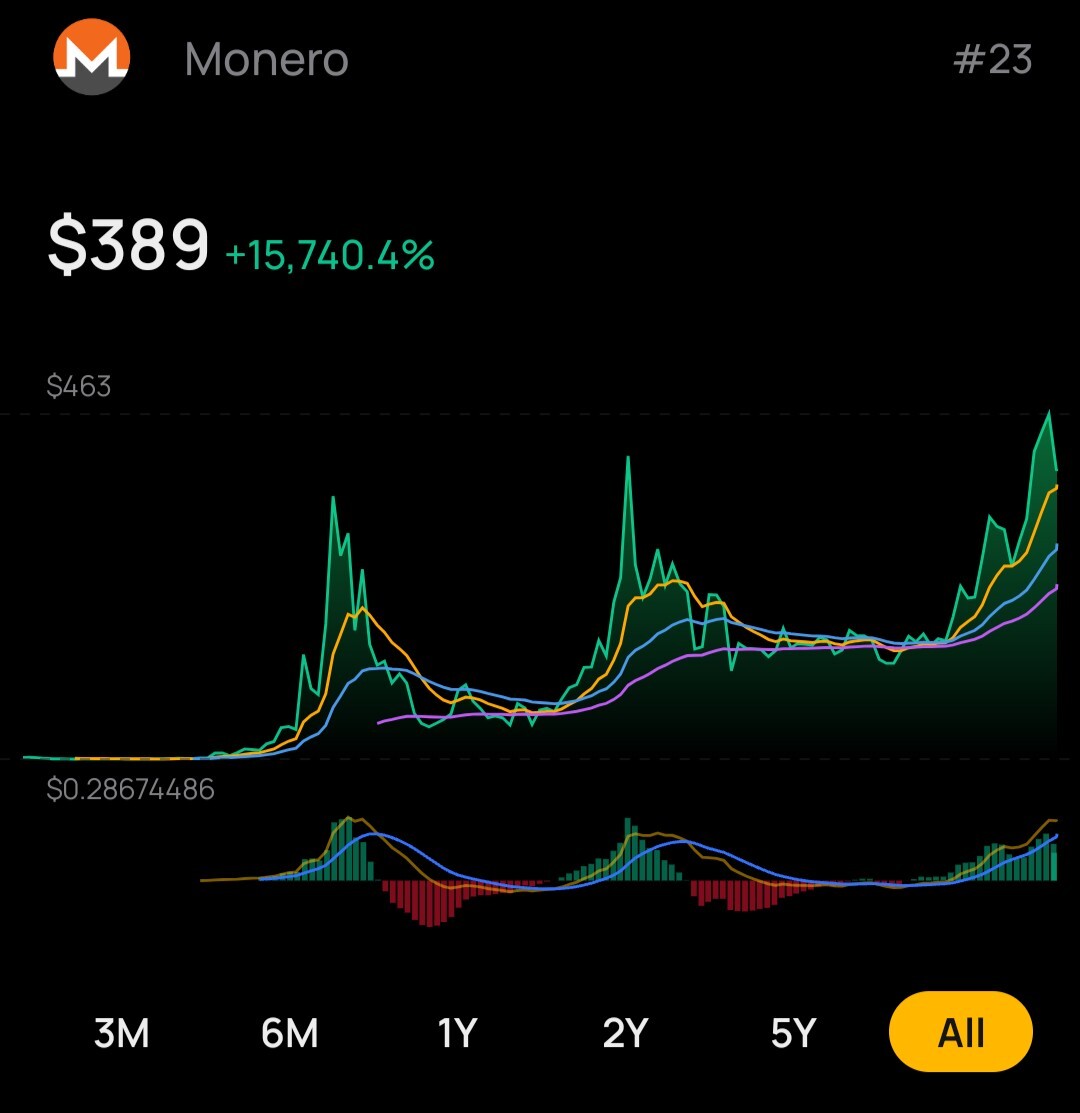
fantastic!
for mining, should i solo or p2p pool?
P2pool if you want to receive your rewards in a reasonable timeframe, there’s almost no reason to solo mine… but there is something cool about it and finally finding that block so personally that’s what I do. https://odysee.com/@crypt0_bear:7d/solo-minning-monero-music-video:1
Cryptocurrency development makes a whole bunch of arbitrary value-guided decisions during creation, all of these decisions have tradeoffs such that nobody has figured out a way to feature them all at the same time, or would they want to.
For example, bitcoin is fully auditable. Anyone with a copy of the bitcoin blockchain can review every single transaction in bitcoin’s history, and trace the flow of every last satoshi from it’s mining to today. This is because the developers of bitcoin place a high value on verifiable auditability and security. Conversely monero was developed for the purpose of being a completely untraceable, unauditable currency that still has a knowable supply. And ethereum was created in a manner that intentionally supported scripting, so that it could be used as a platform for novel applications and contracts. None of these primary features could be ported to either of the other two without breaking them completely, because of the deep programmatic implications of the requirements.
It’s not really a question of better or worse, but of use case. The fact of the matter is that the reason these three examples are the leading currencies for their use case is literally because nobody has yet been able to do a better job. And for bitcoin at least, at this point it’s security rests just as much in it’s wide adoption and interest as it’s design intent, so it’s unlikely that anyone ever will.